


- Home
- News Room
- Patient Stories
- First Living Donor Liver Transplant in Kansas

March 31, 2026
Liver disease stole Brandon Morrison’s ability to fully enjoy his life for years. But in 2024, that changed when Brandon became the first person in Kansas to undergo a liver transplant from a living donor.
“I was pretty sick, especially in the beginning when I was first diagnosed. I couldn’t do a lot,” Brandon says. “I couldn’t be active, and I missed so much stuff with my kids. It was pretty bad.”
The liver disease caused Brandon significant issues with ascites – fluid buildup in the abdomen causing a swollen belly – and always being cold. Those issues made it difficult to spend time outside or go to events.
“Your liver affects a lot,” Brandon says. “Your body goes through a lot of changes that people don’t realize.”
Timothy Schmitt, MD, director of transplantation at The University of Kansas Health System, explains that advanced liver disease can wreak havoc on a person’s whole body.
“With liver disease, you actually have muscle wasting, fatigue, problems with your brain,” Dr. Schmitt says. “Liver disease takes away your muscle, energy, strength, heat, everything.”
It’s just not that common to have a living donor liver transplant program because it’s a risky operation, and you have to have the technical expertise to do it. There’s a lot of moving parts and a lot of things you have to get in place to make sure it’s the right time and that you have the right team and the right people with the right training." Timothy Schmitt, MD
Director of transplantation at The University of Kansas Health System
Change in transplant allocations
In 2020, organ allocation for liver transplants changed dramatically for patients in the Kansas City region. Patients had to be much sicker than before to get a liver from the cadaveric list. This meant a group of patients was lost in the middle: sick enough to need a transplant but not sick enough to get one.
Which is exactly where Brandon fell.
Then, in 2024, after living his life on medications that improved his condition just enough so he could stay home instead of in the hospital, a new opportunity arose. The Center for Transplantation at The University of Kansas Health System launched a living donor liver transplant program.
“It’s just not that common to have a living donor liver transplant program because it’s a risky operation, and you have to have the technical expertise to do it,” Dr. Schmitt says. “There’s a lot of moving parts and a lot of things you have to get in place to make sure it’s the right time and that you have the right team and the right people with the right training.”
Dr. Schmitt recognized that fellow transplant surgeon Clay King, MD, had the talent, interest and desire to devote to the program. The health system had the right people and expertise in place.
Marina Tosi
Every time I talk about it, I'm like, do you want to see my scar? It's kind of cool. I mean, it's not as cool as yours, but ...
Speaker 2
There are very few scars that make you feel proud, like you change for the better and even save someone's life. Marina has that. She donated part of her liver to her friend Brandon.
Brandon Morrison
It was like immediate change. I went from feeling bad all the time to feeling like Superman.
Speaker 2
Here's how a living transplant works. A donor gives half of their healthy liver to a recipient. The liver grows back to normal size in both donor and recipient.
Clay King, MD
I paint a pretty realistic, and I don't pull any punches when I say how the post-op recovery is going to be and how big the incision is going to be, and hospital stay and things like that.
Speaker 2
Marina spent days in the hospital and took weeks off work. Her mother came from Brazil to help her recover, a sacrifice Brandon felt almost immediately.
Brandon Morrison
I had walked in the hospital during recovery. I walked two miles, I think it was. One mile one day, one the, you know, the next day, just walking around. I haven't done that in years.
Speaker 2
Time rolls by from the hospital to a ball game. Look closely and you'll see Dr. King too. This would have been unthinkable for Brandon before his transplant.
Brandon Morrison
I missed so much stuff with my kids and just everything. Going outside, I was always cold. I mean, your body goes through a lot of changes that people don't realize. Your liver affects a lot.
Speaker 2
It's his new reality. Living a full life.
Brandon Morrison
Not everybody gets that opportunity for a gift that's going to save your life and change you.
Speaker 2
Marina will tell you her life changed, too.
Marina Tosi
You could save a life. I don't work in anything that I could save lives otherwise, different than doctors and many other professions. So saving a life is something I would never take for granted.
Living donor volunteers
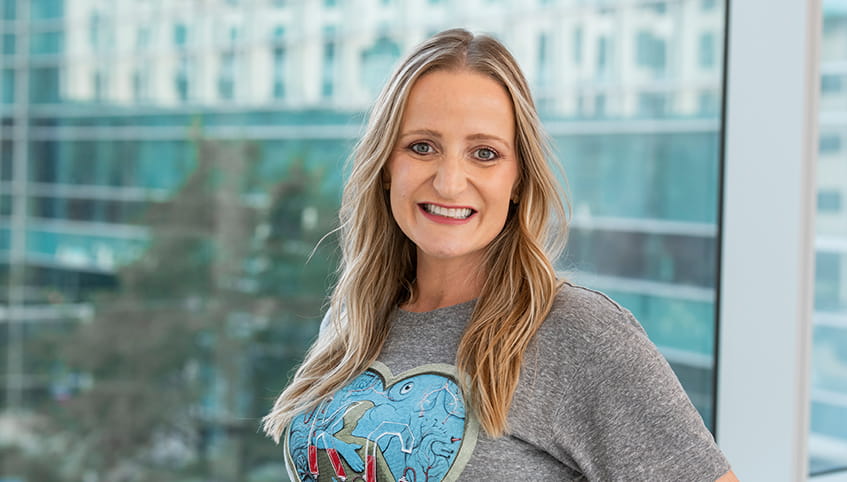
With the living liver transplantation program in place, Brandon needed a donor. Almost immediately, one of his friends stepped up and volunteered. Marina Tosi knew Brandon and his family well, and she saw what Brandon was going through.
“I just thought, ‘If I’m healthy enough right now that I can do this, then why wouldn’t I?’” Marina says. “Then I met Dr. King, and it was just perfect, like the stars aligning. I had no way of saying no to that.”
Marina says Dr. King and his team educated her and gave her the confidence about the process that she needed. She knew she was in good hands.
An independent living donor advocate, who is a liaison between the transplant center and the potential donor, has to determine whether the potential donor is donating of their own free will before the medical screening can begin.
To determine whether Marina was a good match for Brandon, she underwent a battery of tests and exams, a detailed health history and lab work. The transplant team also worked up a safety profile to ensure there was as little risk as possible to Marina.
“I came in and said, ‘Educate me,’ because I didn’t know anything about the process,” Marina says. “They’d ask me if I had more questions and I didn’t know what questions I should ask. Mostly I asked about after my surgery, if I would have any limitations, if my life would be the same and about the risks.”
Dr. King answered her questions and explained what they were going to do. Her liver was healthy, was a blood type match and she had enough liver mass to donate what Brandon needed and leave her with a large enough remnant for herself.
“Your liver is either transplantable or it’s not; there’s no halfway,” Dr. King says. “And if a donor has a healthy liver, the rule is we have to leave the donor with at least 30% of their total liver volume.”
Once the steps were completed, Marina was cleared as a donor and it was determined she had enough liver volume to donate to Brandon. The transplant moved forward.
Living life to the fullest
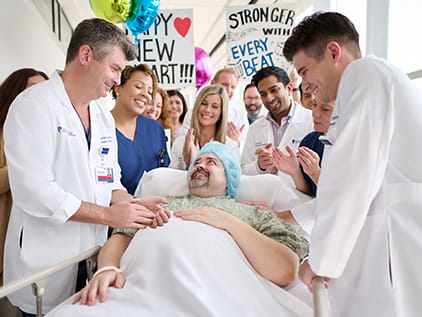
Marina and Brandon both spent days in the hospital following the transplant. Marina took several weeks off work. Her mother came from Brazil to help her recover. Brandon felt the results of her sacrifice almost immediately.
“It was like immediate change,” Brandon says. “I went from feeling bad all the time to feeling like Superman. I walked in the hospital during recovery and walked a mile one day and a mile the next day. You know, just up and walking around. I hadn’t done that in years.”
Now Brandon has his life back. He’s outside, spending time with his wife and kids, going to ball games, traveling. “I feel good all the time now,” he says.
Marina says she felt completely back to being herself just a few months after the surgery and was back playing volleyball in January 2025.
The most meaningful part of this experience for Marina?
“To see Brandon like this,” she says. “There’s nothing more rewarding than that.”
Exploring the gift of life
Could organ transplant be right for you? Request an evaluation today. Our team will be happy to talk with you and support you through your health journey.