


- Home
- News Room
- Patient Stories
- Trauma Team Saves Young Mother

April 30, 2026
When Abbi Winters arrived at The University of Kansas Health System, she was fighting for her life. Moments earlier, a child custody exchange had turned into a violent ambush. As she sat in her car, her ex partner approached with a shotgun and fired 3 times. “I heard something loud. I didn’t know it yet, but I had already been shot twice. I went to cover my face and apply pressure, and there was nothing there,” she recalled. “It hit the window, because the window was up. A bunch of metal shards hit me everywhere, so it’s not like I was shot in one place. I was shot in like a hundred places.”
Despite catastrophic injuries, Abbi stayed conscious, driven by one thought, her son. “Every time he would cry, I would take the deepest breath I could. And I think that’s what made me survive,” she said.
A race against time
Abbi’s injuries were extensive. Paramedics rushed her to the region’s only Level I Trauma Center at The University of Kansas Hospital. “It fractured my spine. It took a piece of my tongue. It took my cheek. The top of my mouth is completely reconstructed from my wrist,” she said. “It was very extensive. I had to learn how to walk and talk again.”
Trauma surgeon Erich Wessel, DO, remembers the urgency. “She was not stable. These were life threatening injuries, and we had to operate immediately,” he said.
“The biggest concern we have up front is injuries to the vital organs, like the lungs and the heart. All the blood for the entire body is going through that area every single second,” said Dr. Wessel. “In Abbi’s case she had a hole in her heart which needed repaired and a hole in her lung which needed repaired. It took a lot of surgical work to stabilize her.”
A team approach
Abbi’s injuries required multiple surgeries and a systematic approach. Once the trauma surgery team stabilized Abbi, surgeons and specialists across multiple departments including cardiothoracic surgery, plastic surgery, critical care and respiratory therapy coordinated her care.
Abbi credits the team with her survival. “I had the best surgeons. They’re the reason that I’m alive,” she said. She has endured multiple surgeries to address her injuries. “Too many to count,” she said.
“Initially we’re trying to get the structures that you have that were injured back into place. Then from there, we see what defects we have and plan reconstruction. The ultimate goal is to restore form and function,” said plastic surgeon Dr. Michael Lypka, MD. “It's difficult. It takes time, and it takes multiple procedures to get to where you want.”
I had the best surgeons. They’re the reason that I’m alive." Abbi Winters
Trauma patient
Rebuilding what was lost
One of Abbi’s most meaningful surgeries involved her right eye. After losing it in the attack, she received a prosthetic painted to match her son’s. “My blue eye is a reconstruction of my son’s, painted to the exact picture,” she said.
More reconstruction lies ahead. Dental restoration will be one of the final steps. “My teeth are the last thing I want done, but I don’t have enough bone up there yet,” she explained.
As Abbi is making progress in her healing, doctors at the health system continue to guide her long-term recovery. “I think it is invaluable that we have the specialties and care that we do. If any point Abbi and I have a question about her care, I can reach out and they will get right back to me,” said family medicine provider Dr. Hannah Maxfield, MD. “It’s really a benefit of the health system.”
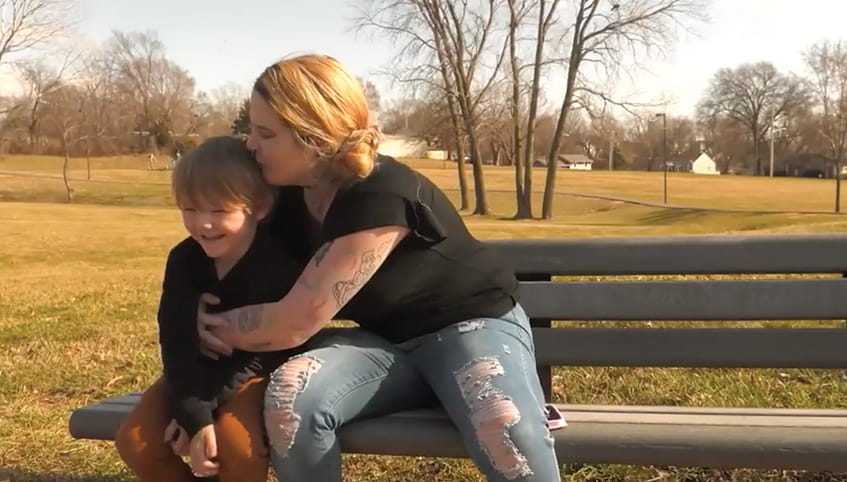
Living with lifelong impact
“The chronic pain never goes away completely,” Dr. Maxfield said, emphasizing the importance of ongoing support for trauma survivors.
The physical recovery has been grueling, but the emotional journey is equally complex. “I had to learn how to walk and talk again,” Abbi said. “My appearance affects me the most. I would dream about my other face and wake up to this.”
Abbi has found healing through social media. Her candid videos documenting recovery have reached thousands. “Most of the videos are just raw and real and those are usually the ones people connect with the most,” she said.
Today, Abbi and her son have moved into their own space, and she has begun speaking publicly about domestic violence. “I just want every person to understand that they deserve the love that they give,” she said.
911 Dispatcher:
You’ve reached Wyandotte County 911, do you need police, fire or medical?
Abbi Winters, Trauma Patient:
I heard something loud. I didn't know it yet, but I had already been shot twice with some kind of rifle. I went to cover my face and apply pressure, and there was like nothing there. I reached into my mouth like I reached straight up, and there was no cheek right here.
Jessica Lovell, Medical News Network:
Abbi Winters was just 21 years old when she went to pick up her son at his dad's house. That's when her ex emerged from his home pointing a shotgun at the car she was sitting in. He pulled the trigger three times.
Abbi Winters, Trauma Patient:
It hit the window, because the window was up and it was a pretty good window, like a strong window, I guess on a Cadillac. The bullets blew up, so a bunch of metal shards hit me everywhere. So it was not like I got shot in one place. I got shot in like 100 places.
911 Dispatcher:
Is your daughter awake?
Caller:
I can't tell. Yes, she’s breathing.
Jessica Lovell, Medical News Network:
Despite her massive injuries, Abbi remained conscious through it all.
Abbi Winters, Trauma Patient:
I was thinking about my mom and my son because I didn't know if my son was alive in that house. So I was just looking and looking and looking for my son, any sign of him to come out of the house. And then my mom strapped him in the car, and I listened to him cry, and every time he would cry, I would take the deepest breath I could. And I think that's what made me survive, honestly, because every time he would cry I just took the deepest breath.
Jessica Lovell, Medical News Network:
Abby was rushed to the University of Kansas Health System.
Abbi Winters, Trauma Patient:
It fractured my spine. It took a piece of my tongue. It took my cheek. The top of my mouth is completely reconstructed from my wrist. It was just gone. I could stick my tongue into my sinus. It was just very extensive. I had to learn how to walk and talk again.
Jessica Lovell, Medical News Network:
It took a team of surgeons and specialists to keep Abby alive.
Abbi Winters, Trauma Patient:
My face was gone. I mean, it was gone. I had the best surgeons. I mean, waiting and just team in general. They're the reason that I'm alive. For sure. I remember that I woke up here first and I was, I forget what they call it, but they had to restrain me to the bed because I had a trach, so I didn't pull my tubes out in my sleep or something.
Jessica Lovell, Medical News Network:
Once a vibrant young girl, a competitive swimmer even, in good shape, Abbi was now facing a whole new reality.
Abbi Winters, Trauma Patient:
You know, it's a process. It's not like you wake up one day and you feel better, because I don't think that my body will ever feel as great as it did.
Jessica Lovell, Medical News Network:
The miraculous part she survived. But the worst part…
Abbi Winters, Trauma Patient:
I really feel like my whole motherhood was stripped from me. I couldn't pick him up. He couldn't be on top of me. I couldn't lift more than like five pounds.
Jessica Lovell, Medical News Network:
The physical pain is real and still there every day, but the scars show a different pain.
Abbi Winters, Trauma Patient:
My appearance affects me the most. Like at first, it broke my heart. I would dream about my other face and wake up to this. It was exhausting,
Jessica Lovell, Medical News Network:
But she's living each day for her son and finding purpose through tragedy.
Abbi Winters, Trauma Patient:
I’m finally adjusting. And I think that this is what I'm supposed to look like, and this is what you know God had intended for me.