
- Home
- News Room
- Patient Stories
- Coming Back Stronger

September 01, 2026
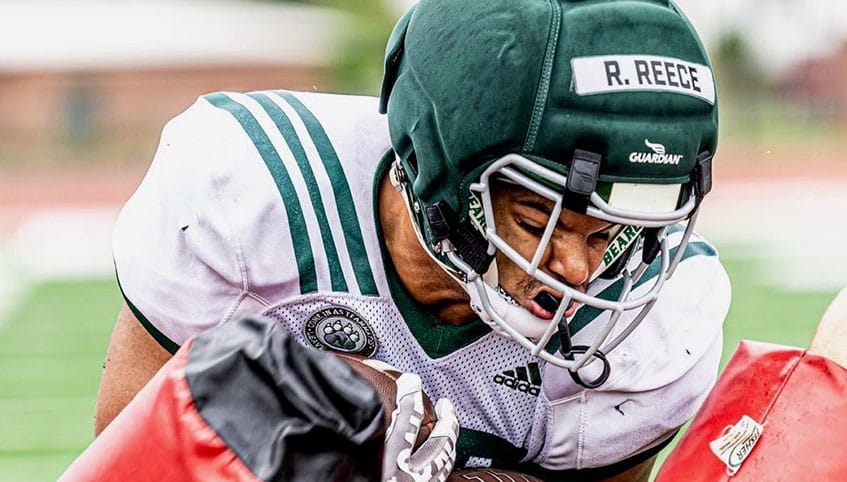
When Reginald (Reggie) Reece gets knocked down, he gets back up.
As a rising senior running back on the football team at Mill Valley High School, Reginald (Reggie) Reece had his sights set on playing Division 1 football. It wasn’t a farfetched dream. He had offers on the table but had been waiting for a few more before making a final decision.
In June 2025, before his senior year, he tore the meniscus in his left knee during a scrimmage. But Reggie kept going. He continued to play while caring for the injured knee. His hope of continuing ran out during week 5 of his senior season.
“I was playing through it against Olathe West. My leg got extended out, and one of my teammates got pancaked onto my knee,” he says. “I felt the shift in my knee when I got up. I knew it was over.”
Reggie had torn the MCL on his right knee. Before the MRI and official diagnosis, Mill Valley High School athletic trainer Jake Brownback knew the injury was going to be serious.
“I had my assessment, and I was suspecting MCL, but a lot of times those warrant MRIs just because you don’t know what’s going on in that joint space. I’m listening to Reggie, the caliber of athlete he is, and what he’s reporting back starts running red flags,” says Brownback.
Although Brownback works at the high school, he is an employee of The University of Kansas Health System and collaborates closely with our physicians, surgeons and physical therapists. He sent Reggie to Bryan Vopat, MD, orthopedic surgeon, for an evaluation.
Dr. Vopat diagnosed Reggie with a posterior medial root tear on his left knee and an MCL tear on his right knee. Both needed surgical repair.
“We did the MCL first on the right side because it was a faster recovery time, and the MCL is better to do sooner rather than later so we could repair it back down,” says Dr. Vopat. “On the left side where he had to have the root done, he had to be nonweight bearing completely for 6 weeks.”
Dr. Vopat said this approach was used to reduce Reggie’s recovery time as much as possible and ensure he could train for college football in the spring.
A team effort to return to play
Reggie was used to working hard, playing through discomfort and gritting it out. But these injuries presented him with a completely new experience.
“These were my first surgeries ever,” he says. “I’ve never broken or torn anything. And the recovery process was long.”
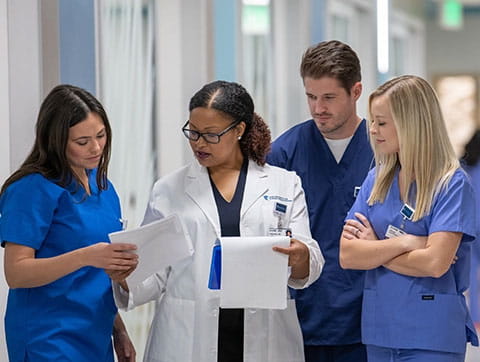
After surgery, Reggie also began working with working with Jennifer Talone, a physical therapist at the Sports Medicine and Performance Center. Brownback described this triangle, the physician, physical therapist and athletic trainer, as an incredible benefit to student athletes at health system partner schools.
“When it comes to these long-term rehabs, the athlete needs to lean on physical therapy in a 1-on-1 care setting. But we're constantly communicating. I can supplement it at school. I can look at their charts and see what exercises they’re doing. We're very much able to tag team and kind of go back and forth,” Brownback says.
In addition to his care team, Reggie says he relied on the support of his friends and family to mentally and physically recover.
“I’m very based in the faith. My Lord is watching over me. I questioned why it had to happen to me, but I feel like it’s good because I’d rather it happen to me in high school than have it happen in college,” Reggie says. “Mentally overall, I feel like it was a step up to become stronger overall. I’ve always had a strong mentality; that’s why I never quit in football.”
Brownback says Reggie always had the work ethic to come back.
“He’s very much a gym rat. He wants to do the dirty work, not afraid to sweat and get after it. When you have a person like that, you don’t have to push them to come in every day. They’re actually pushing you,” Brownback says. “We had some conversations to explain, with your knee, you can’t do that. We can still push upper body. We can work on other things so when you come back, you’re ready to go. Yes, the season is done, but your career is not done. He adopted that mindset fully.”
Some of the college offers Reggie had received were lost after his injury. But not everyone disappeared. Northwest Missouri State University continued to reach out.
“I was shocked. They still wanted me and took me,” Reggie says. “I’m a running back, and I’ll be playing as a freshman.”
Reggie was cleared for his MCL at the beginning of February and his meniscus at the start of May. He headed to Northwest at the end of that month to start college football workouts.
“I definitely got my butt a little handed to me,” Reggie says. “But overall, my knees have been doing great. I feel like I’m stronger. I lift heavier now. I feel faster, more explosive.”
While Reggie deserves most of the credit for his dedication and results, he praises his team at the health system, too.
“Jake is a great, great athletic trainer. One of the best in the state I feel like," Reggie says. He continued to praise the PTs and staff at the Sports Medicine and Performance Center as well. “They’re the best,” Reggie says.
His advice to other athletes in a similar situation?
“(The health system) will get you taken care of, for sure. If you feel like you’re going to be weaker or not the same afterwards, you’ll be fine,” he says.
Reggie is looking forward to being a Bearcat this year. The team has previously led their conference in rushing.
“They’re a run-the-ball team. That’s what I’m looking forward to for sure,” Reggie says.
Brownback says the sky is the limit for Reggie.
“The knee injuries are not going to stop him. Northwest is a great football school. He has the ‘it factor’ that you can't really teach. So, I can see him having a really, really good college career,” Brownback says.