


- Home
- News Room
- Patient Stories
- Living Organ Transplants Give New Hope

August 19, 2026
Christina Schadeggs and Brie Bauer faced very different medical challenges, but both ultimately depended on the same lifesaving solution.
Thanks to advances in transplant medicine and the expertise of The University of Kansas Health System, both women received a living organ transplant, with one receiving part of a liver from an anonymous donor, and the other receiving a kidney from her brother.
Needing a new liver
For nearly a decade, Christina lived with primary biliary cholangitis (PBC), an autoimmune disease that attacks the liver's bile ducts. As the disease progressed, bile built up within her liver, causing inflammation, scarring and eventually cirrhosis. Severe fatigue became one of her most debilitating symptoms.
"I just was pretty tired," Christina said. "An overwhelming sense of fatigue would hit me, and I couldn't do anything."
Under the care of hepatologist Ryan Taylor, MD, Christina learned that she would eventually need a liver transplant. Dr. Taylor explained that PBC damages the bile ducts, causing bile to back up into the liver and gradually destroy healthy tissue.
The challenge was that patients with PBC often don't quickly qualify for a deceased donor liver, even while experiencing significant symptoms. The MELD score (model for end-stage liver disease) helps decide how urgently someone needs a liver transplant.
“The problem with a disease like PBC is that the scoring is disadvantaged because they don’t get as high a MELD score,” said transplant surgeon Tim Schmitt, MD. “She could wait a long time, feeling terrible and being sick, but her MELD score never gets high enough to get a high score on the transplant list.”
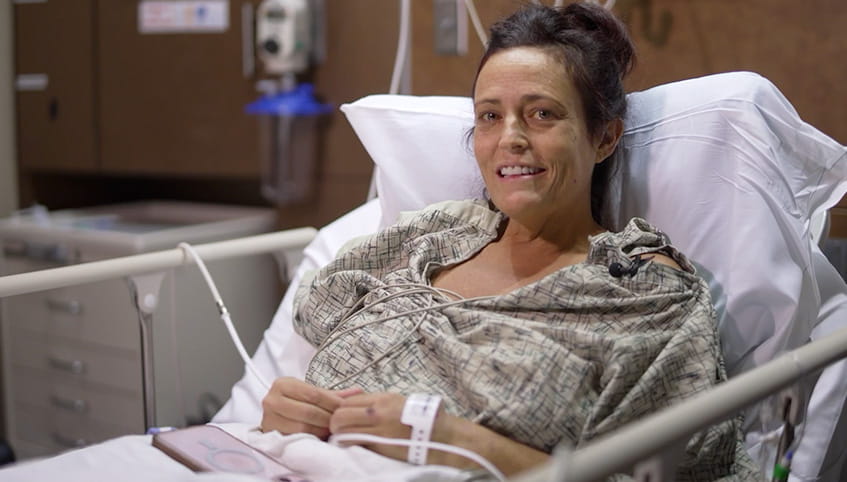
Thriving after transplant
Fortunately, Christina became a candidate for a living donor liver transplant. An anonymous donor volunteered to give a portion of their liver, allowing Christina to receive a transplant before her condition worsened.
In a living liver transplant, surgeons remove a portion of a healthy donor's liver and transplant it into the recipient. Because the liver can regenerate, both the donor's remaining liver and the transplanted portion grow back to meet the body's needs. Dr. Schmitt explained that within weeks, both the donor’s and recipient’s livers regenerate to roughly 85 to 90% of their normal size.
Months later, Christina is thriving.
"She's a completely different person from the day I met her," Dr. Taylor said. "She has an excellent prognosis. She should have a normal life."
Dependent on dialysis
Brie Bauer's transplant journey began with a catastrophic health crisis. In 2024, she developed a rare infection that led to sepsis while pregnant with her youngest son. Doctors performed an emergency C-section to save her baby, and the measures required to save Brie's life ultimately resulted in the loss of all four limbs.
The severe illness also damaged her kidneys, leaving her dependent on dialysis.
"The biggest limitation it has is time," Brie said. "That is what dialysis has taken away."
Dialysis kept her alive but consumed hours each week while she was simultaneously undergoing rehabilitation and learning to adapt to life as a quadruple amputee. A kidney transplant offered her best chance at long-term independence and improved health.
Then came an extraordinary birthday surprise. Brie's brother, George, revealed that he had been tested and was a perfect donor match.

Protecting the patient and the donor
Before any living donation takes place, transplant teams conduct extensive evaluations to ensure the donor's safety. "What makes a good donor is they are very healthy. We want them to be in the best possible shape, which really protects them," said transplant surgeon Sean Kumer, MD.
Once George was approved, two surgical teams worked in adjacent operating rooms. One team removed George's kidney while another prepared Brie for transplantation. The process requires extraordinary timing and coordination.
"It's kind of like a dance," Dr. Schmitt said. "He's getting the kidney out, and we're timing when the recipient should go."
The response to a kidney transplant can happen immediately, even in the operating room. "Most of the time, these kidneys work immediately right on the table and start making urine," Dr. Schmitt said. "A lot of patients don’t know how bad they felt and start feeling better the next day."
For Brie, the transplant meant freedom from dialysis and the ability to focus on her family, recovery and future.
For some patients, living donation may be their only option to be transplanted." Clay King, MD
Transplant surgeon and director of the living liver program
Providing an option for transplant
Living organ transplantation is unique in that it focuses on the health of both the donor and recipient. "I love this part of my job because you're able to help two people through this process," said Dr. Kumer.
For patients, living donation can significantly shorten the time to transplant, reduce the risks associated with prolonged organ failure and allow surgery to take place before a patient's condition becomes critical.
“For some patients, living donation may be their only option to be transplanted," said transplant surgeon and director of the living liver program Clay King, MD.
As transplant science continues to advance, living organ donation is providing more patients with access to lifesaving treatment and giving them the opportunity for better long-term health outcomes and improved quality of life.

Real patient stories. Life-changing healthcare.
Choices, Hope and Science is a special 8-part series highlighting patient journeys, advancements in medicine and our dedicated clinicians partnering in treatment and recovery.