


- Home
- News Room
- Patient Stories
- Stroke Treatments Give New Hope

July 27, 2026
For 5 years, Dr. Jennifer Milner believed her stroke recovery was over.
The emergency room physician from Wamego, Kansas, suffered a stroke while facing one of the busiest and most challenging periods of her life. She was battling brain cancer and raising a young child when the stroke left her with weakness in her arm and hand. Despite completing physical therapy, her progress eventually stalled.
"I just kind of plateaued," Dr. Milner said. "I assumed that's how my life was going to be."
Like many stroke survivors, she learned to adapt. She found new ways to complete everyday tasks and accepted that certain abilities might never return.
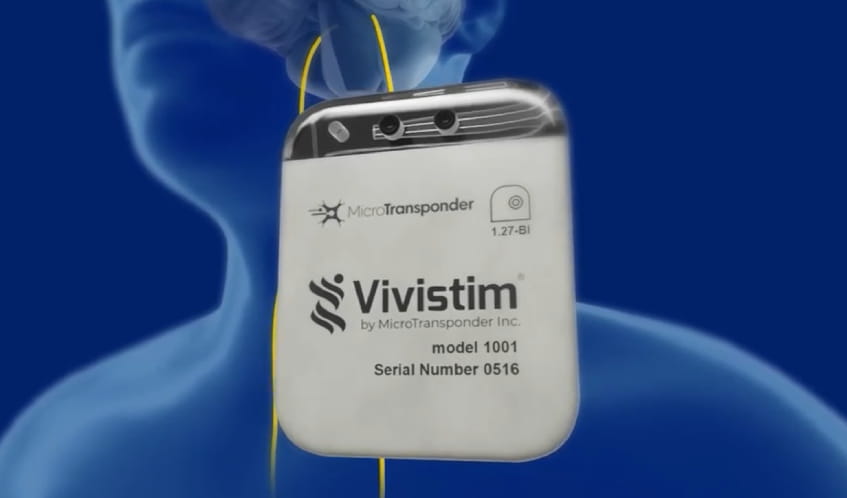
Then her rehabilitation physician told her about Vivistim, an implant that works alongside physical and occupational therapy. The device provides vagus nerve stimulation (VNS), helping the brain strengthen connections involved in movement and recovery.
First in the region
The University of Kansas Health System was the first hospital in the region to provide VNS for ischemic stroke survivors. “It’s a newer use for the device, but it's a device that most all neurosurgeons are very familiar with through their training,” said neurosurgeon Christopher Miller, MD. The implant has been used for years to treat epilepsy and was FDA-approved to treat motor function in ischemic stroke survivors.
The implant was placed during a relatively simple surgical procedure. A small battery was implanted in her chest and connected to electrodes wrapped around the vagus nerve in her neck.
Dr. Miller says that while the surgery is straightforward, the real work begins afterward. Patients must commit to intensive therapy, using the stimulation while repeatedly practicing functional movements.
Embracing the challenge
Dr. Milner embraced the challenge. She attended therapy 3 times a week and completed exercises at home several times each day.
"Vagus nerve stimulation enhances the brain's ability to adapt and relearn after stroke," said Vice Chair for Stroke Translational Research at the University of Kansas Medical Center Sandra Billinger, PhD. "When stimulation is paired with meaningful rehabilitation exercises and everyday activities, it reinforces the brain circuits responsible for those movements, helping recovery become more effective."
The process was demanding, both physically and mentally. Dr. Milner spent hours performing exercises that appeared simple but required tremendous effort. She repeatedly picked up and dropped small balls, teaching her brain and body to work together again.
We've thought for a while that after a stroke, things are kind of what they are. But having the opportunity for patients to get better afterwards is a big deal, and it's exciting to be a part of that.” Christopher Miller, MD
One movement at a time
According to rehabilitation specialists, that's exactly how the brain learns. New pathways are built through repetition, one movement at a time.
Within a few weeks, Dr. Milner began noticing changes. Formal testing showed measurable improvement after 6 weeks, but she had already started seeing results at home. Everyday activities were becoming less frustrating.
Then came a moment she will never forget.
Before treatment, Dr. Milner often needed help lifting her youngest child. After months of therapy, she realized she could pick him up on her own. "The small things turned out to be big things," she said.
The improvements extended beyond her home. As an emergency physician, she regained confidence in certain procedures that had felt difficult after her stroke. While she still has goals she hopes to reach, she finally sees progress where she once saw limitations.
Advancing treatment for stroke patients
For interventional neurologist Michael Abraham, MD, Dr. Milner’s story represents something bigger than one patient's success. For years, many stroke survivors believed recovery largely stopped after the first several months, but treatments like Vivistim are challenging that assumption. “In my 12-plus years of doing this and seeing stroke patients, I feel this is the first thing we have that has shown a positive impact on stroke survivors,” said Dr. Abraham.
The implant is not a cure, and it does not replace therapy. Recovery still requires dedication, repetition and hard work.
Five years after believing she had reached her limit, Dr. Milner discovered that recovery was still possible.
“We've thought for a while that after a stroke, things are kind of what they are. But having the opportunity for patients to get better afterwards is a big deal, and it's exciting to be a part of that,” Dr. Miller said.


Real patient stories. Life-changing healthcare.
Choices, Hope and Science is a special 8-part series highlighting patient journeys, advancements in medicine and our dedicated clinicians partnering in treatment and recovery.